
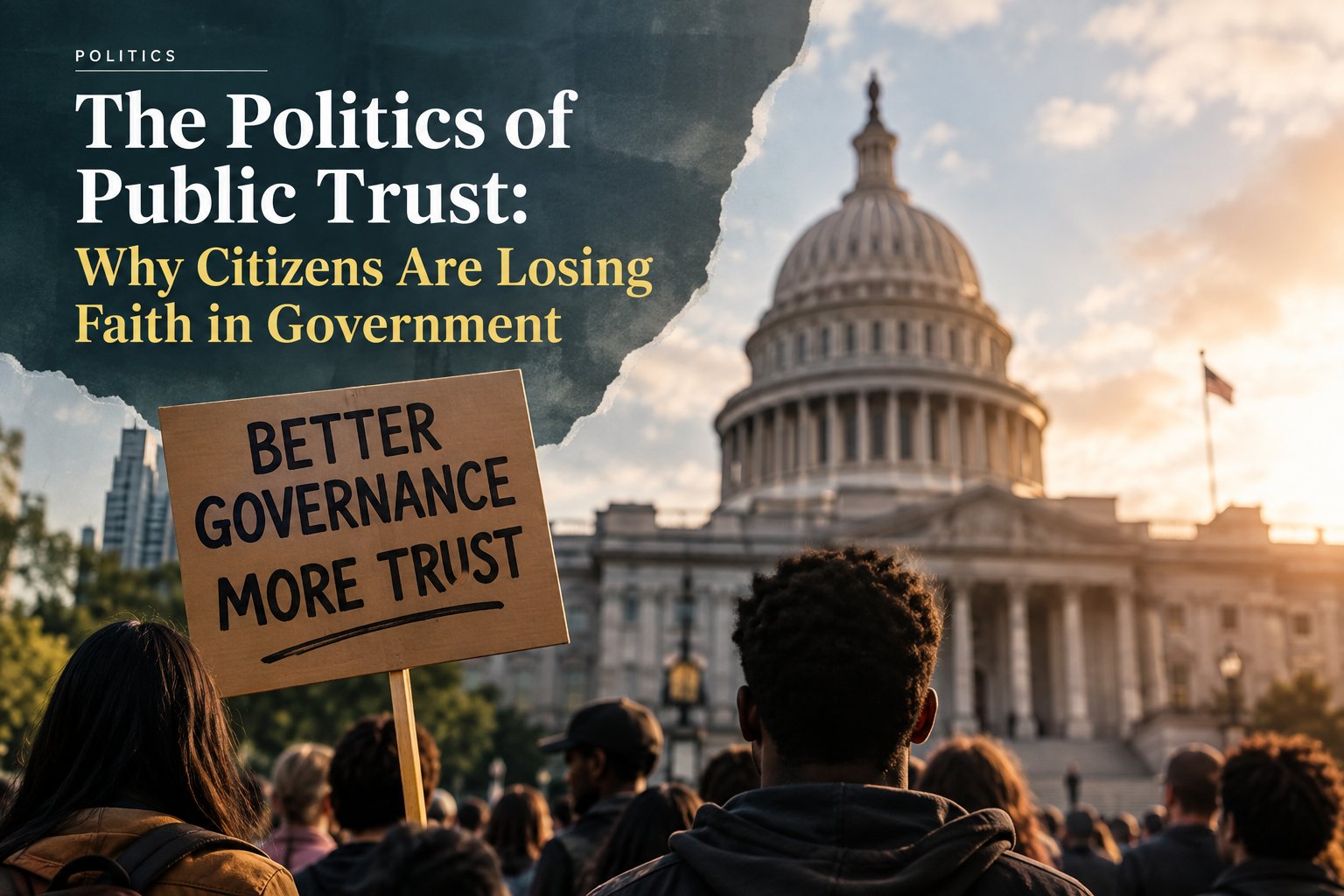
Trust has always been one of the most important currencies in politics. Governments can pass laws, collect taxes, build institutions, and create policies, but their ability to govern effectively ultimately depends on whether citizens believe those institutions are acting in the public interest.
In many democracies, however, that relationship has become increasingly complicated. Citizens are more willing to question political leaders, challenge official statements, and demand evidence before accepting government explanations. While skepticism can be healthy in a democracy, persistent distrust can make it significantly harder for governments to implement policies, respond to crises, and maintain social cohesion.
One major reason for this decline in confidence is the growing distance between political promises and citizens’ everyday experiences. During election campaigns, politicians often present ambitious visions for economic growth, better infrastructure, improved public services, and greater accountability. Once elected, however, governments frequently discover that delivering those promises is considerably more difficult than communicating them.
The result can be a widening gap between expectations and reality. A citizen who repeatedly hears promises about improved healthcare but continues to encounter overcrowded hospitals may eventually stop believing political messaging altogether. The same applies to employment, education, transportation, security, and other areas where government performance directly affects daily life.
The rise of social media has fundamentally changed the relationship between politicians and the public. Political communication was once largely controlled by newspapers, television stations, radio broadcasters, and official government channels. Today, a political statement can reach millions of people within minutes without passing through traditional media institutions.
This has created new opportunities for political participation. Citizens can directly question elected officials, organize campaigns, share information, and draw attention to issues that may otherwise receive little coverage. Grassroots movements can develop rapidly, sometimes forcing governments and political parties to respond to issues they had previously ignored.
At the same time, the speed of online communication creates serious challenges. Political discussions can become dominated by emotionally charged content because controversial claims often receive more attention than careful explanations. A misleading headline or edited video can travel across multiple platforms before journalists, researchers, or government officials have an opportunity to verify it.
Political parties have also learned to take advantage of these dynamics. Campaigns increasingly rely on targeted messaging designed to appeal to specific groups of voters. While targeted communication can make political campaigns more relevant, it can also contribute to political polarization when citizens are repeatedly exposed to information that reinforces their existing beliefs.
Elections are essential to democratic government, but voting every few years cannot be the only mechanism through which citizens hold political leaders accountable. Effective democracies require institutions that allow the public to scrutinize government decisions continuously.
Parliaments, courts, independent journalists, auditors, civil society organizations, and anti-corruption institutions all play important roles in this process. Their effectiveness depends not only on the laws that establish them but also on their independence and ability to operate without inappropriate political interference.
Transparency is particularly important. Citizens are more likely to trust institutions when they can understand how important decisions are made and how public money is being spent. Publishing budgets, procurement information, legislative records, and government performance reports can make it easier for the public to evaluate whether officials are meeting their responsibilities.
Accountability also requires political leaders to acknowledge mistakes. No government will make every decision correctly, and pretending otherwise can ultimately damage credibility. A leader who openly explains what went wrong, identifies the lessons learned, and outlines corrective action may strengthen public confidence more effectively than one who simply denies criticism.
Restoring political trust is unlikely to happen through a single speech, campaign slogan, or policy announcement. Trust develops gradually through repeated interactions in which institutions demonstrate competence, fairness, transparency, and responsiveness.
Governments can begin by focusing on measurable outcomes rather than political rhetoric. Instead of simply announcing that a new initiative has been launched, officials can provide regular updates showing how many people have benefited, how much money has been spent, what challenges have emerged, and what remains unfinished.
Citizen participation should also extend beyond elections. Public consultations, town-hall meetings, community forums, digital feedback systems, and participatory budgeting can give citizens meaningful opportunities to influence decisions that affect them.
Ultimately, political trust is built when citizens feel that government institutions see them as participants rather than spectators. Democracy works best when people believe their voices matter and when political leaders understand that winning an election is not the end of their relationship with voters, but the beginning of a responsibility to serve them.
The challenge for modern politics is therefore not simply convincing citizens to trust government again. It is creating institutions and political cultures that consistently earn that trust.
